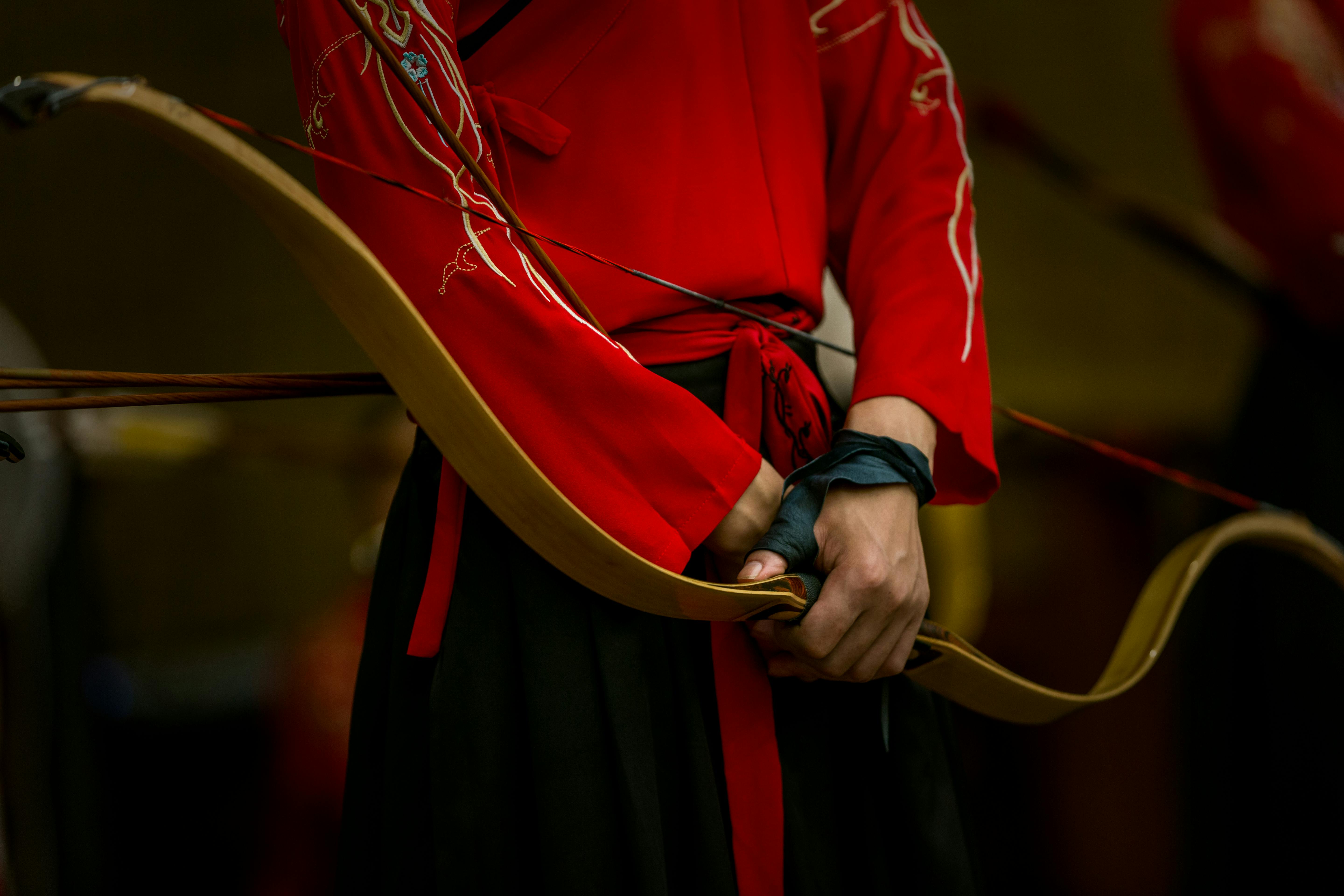
In Japan, the practice of archery is known as Kyudo—the Way of the Bow. Rooted in Zen Buddhism and Shinto rituals, Kyudo is considered a path of self-cultivation and active meditation. The focus is not on hitting the target, but on executing the ritual movements with absolute presence and clean posture. If the form is correct, the hit occurs naturally.
The Asymmetric Yumi Bow
The primary weapon of Kyudo is the yumi—a massive bow standing over two meters tall. Unlike symmetrical Western bows, the yumi's grip is located at the lower third of the bow, rather than the center. This asymmetric design allows the archer to stand and kneel comfortably, and reduces hand shock (vibration) upon release, as the upper limb's longer length absorbs the recoil energy. Traditionally, the yumi is built from laminated bamboo and wood strips glued with natural fish adhesives.
"In Kyudo, the arrow is not aimed at the target; it is aimed at the self. The release is a letting-go of the ego, allowing the string to slip naturally from the hand."
The Hassetsu: Eight Stages of the Draw
Every shot in Kyudo follows a rigid, choreographed sequence called the 'Hassetsu' (Eight Stages):
- Ashibumi: Placing the feet to establish a stable stance.
- Dozukuri: Correcting the posture and centering the spine.
- Yugamae: Preparing the bow hand and hooking the string.
- Uchioroshi: Raising the bow overhead.
- Hikiwake: Drawing the bow down and outward.
- Kai: The full draw state, where the archer breathes deeply and waits for the release.
- Hanare: The natural release, occurring without conscious intent.
- Zanshin: Holding the posture after the shot, reflecting on the state of mind.
The Spiritual Release
Kyudo archers wear a specialized three-fingered leather glove (yugake) with a hard resin thumb. The release occurs when the archer slightly rotates their wrist, causing the string to slip out. The bow rotates in the hand upon release, a motion called 'yugaeri,' wrapping the string around the outer arm in a elegant spiral.